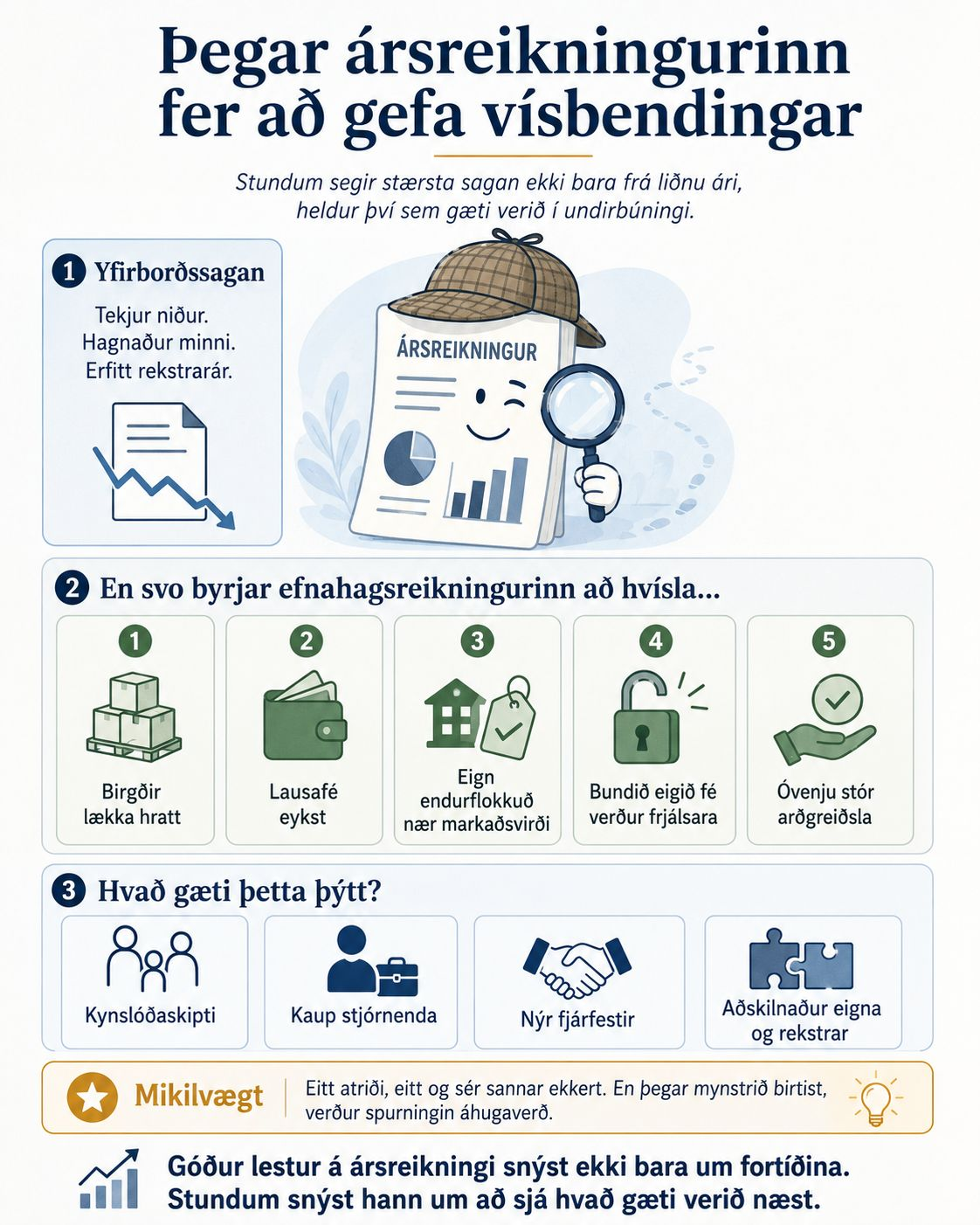
I recently analysed the annual accounts of a company that had had a difficult trading year.
Revenue had fallen and profit had declined.
At first glance, the story seemed simple:
A difficult year. External conditions. Lower earnings.
But then I began looking more closely at the balance sheet.
There, another possible story emerged.
When the changes begin to form a pattern
During the year, the changes had included:
- Inventory had been reduced rapidly and cash had increased substantially.
- An asset previously part of ordinary operations had been reclassified and its carrying value brought closer to market value.
- Restricted equity had been transferred into more freely distributable equity.
- The company had built a very strong liquidity position.
- At the same time, a decision had been made to pay an unusually large dividend.
Each of these things can have a perfectly ordinary explanation on its own.
But when they happen together, it becomes interesting to ask:
Is the company simply responding to its operating environment, or is the balance sheet being prepared for something yet to happen?
A change of ownership, for example.
A generational transition?
A management buyout?
A new investor?
Or simply a change in policy on how the company’s assets and capital are allocated?
If the business were to change hands
If the owners intend to sell a business, it does not necessarily make sense for a buyer to have to finance substantial excess cash sitting inside the company.
It may then be logical to distribute some of it beforehand.
The same thinking can apply to inventory.
If it makes up a large part of the balance sheet, reducing it before a valuation or due diligence can be valuable. That reduces uncertainty about its actual value, quality and saleability.
And if a property or another asset is not essential to the core business, it may make sense to distinguish it more clearly from the operations.
That can later make it easier to sell the business without selling all the assets with it.
None of this proves that a change of ownership is coming.
But the changes can make the question worth asking.
The accounts rarely tell us why
Annual accounts tell us what was done.
They tell us far less often why it was done.
That is where analysis comes in.
We do not simply read the profit or loss.
We also examine:
How cash has moved.
What has disappeared from the balance sheet.
What has been reclassified.
How equity is composed.
Where the funding comes from.
And where the money appears to be going.
Looking at these changes together can sometimes reveal a pattern that the income statement alone does not show.
Reading what has not happened yet
Reading accounts well is therefore not just about understanding last year.
It is also about asking what changes between years might tell us about the next steps.
Not to predict the future.
But to see what questions the data itself raises.
Sometimes the biggest story in the accounts is not what happened.
It is what someone appears to be preparing for.